Poultry Psychology
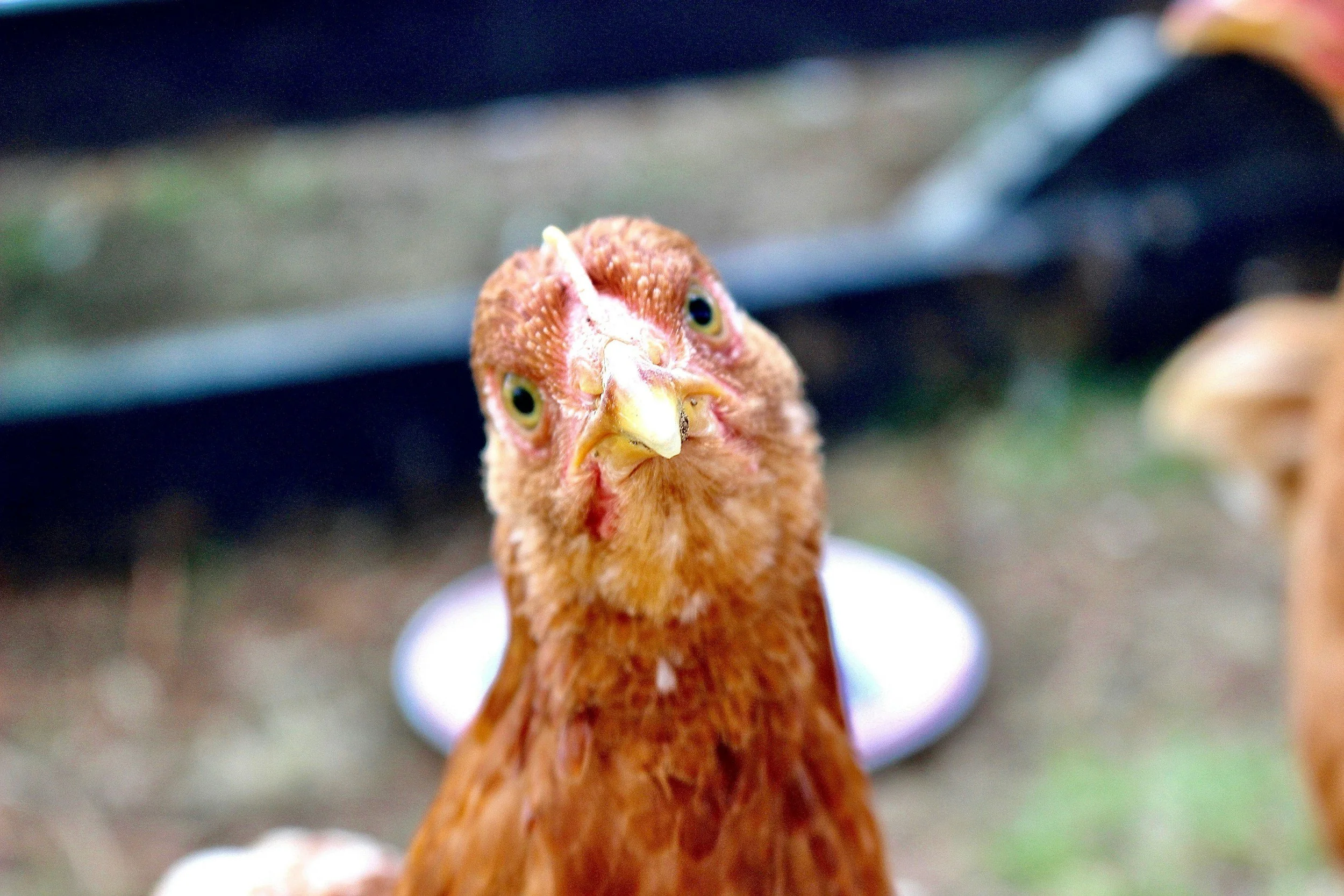
So, here’s the thing: basically, you’re a chicken.
All my best friends have heard me tell stories about my deep affection for my backyard chickens and the many lessons they have taught me. The most meaningful one for me is the process of molting. If you don’t know what molting is, imagine an episode of Naked and Afraid on the Discovery Channel…but starring chickens. With the decrease in sunlight, Mother Nature directs my poor little cluckers to shed every feather once a year so they can grow a new, downy coat for winter.
Molting is miserable, obviously for them, but selfishly, a little for me, too. All their energy goes into growing feathers, so they stop laying eggs. And fresh eggs are kinda the main reason people want chickens. In place of my perpetual pantry, I’m left with tiny naked dinosaurs racing awkwardly around my yard, looking pitiful. Meanwhile, I get no omelets.
But molting isn’t just inconvenient. It’s painful. Feathers grow back like tiny needles pressing through their already thin skin. They withdraw. They sulk. They rest in the coop, unable to forage. This means I have to step in and ensure they’re getting extra nutrients to survive this exhausting process.
Here’s the reason I’m opening with this story (aside from my conviction that chickens convey endless wisdom): humans molt too.
Not with feathers (thank God), but with skin cells, hair, and even whole organs. Every 35 days, you grow a new layer of skin. Every three months, a new liver. Every year, 95% of your atoms are swapped out for new ones. You are literally not the same person you were last year. Basically, you’re a Transformer. Or a Pokémon mid-evolution. Go, Go, Power Rangers? Just pick your favorite.
Growth is not something that’s wrong with you. Molting does not = Illness. It’s not something you can hack, speed up, or cure. And it’s happening whether you like it or not, so stop paying your therapist (I kid, I kid). Even homeostasis, the body’s so-called “balance,” isn’t stasis. It’s an endless process of micro-adjustments that are literally keeping you alive.
But here’s the problem. Most of us grew up with what I call The Gospel of Growth. The entire industrialized wellness and spirituality complex is built around selling us the story that life is one long ladder, one straight line of forward progress. Hit the next milestone. Master the next mindset. Evolve. Get woke. And eventually, you’ll arrive at some stable, enlightened, Instagrammable version of yourself where the work is done.
I know it sounds exhausting, but we never “arrive” at this whole being human thing. I also really wanted to believe that eventually we would get to retire in Florida and phone it in. The social security commercials really indoctrinated me. They lied. This whole being-human thing is hard work.
What there actually is is molt after molt after molt. Painful, inconvenient, occasionally hilarious seasons of stripping down and regrowing. Sometimes you’ll feel like you’re running around the yard naked and afraid. Sometimes you’ll want to hide in your coop and let someone else bring you snacks. Sometimes your friends will be molting, and you’ll need to feed them until they can stand up again.
There is a bright side, though! All this molting is proof of life. Proof you’re still becoming. Proof that even when it looks like everything has fallen apart, something downy and new is already on its way.
And this is why every depth psychologist worth their weight in flock feed is a chickenkeeper. At least I like to pretend we are. We recognize that humans are just chickens (and chickenkeepers), walking each other back to the coop. Reminding each other that even though it’s a painful season of rest, soon we will be strong enough to run around the yard pecking at grain, foraging for grubs, and occasionally dismembering frogs.
I should mention here that sometimes humans are also frogs.
The Awkward Dinosaur Phase
Here’s the trouble: in our culture, growth has been hijacked. It’s no longer a natural, sometimes painful, sometimes hilarious molt. It’s a cult. The Cult of Positivity preaches that if you just think the right thoughts, buy the right journal, or chant the right affirmation under a supermoon, you’ll never feel lost again. And if you do feel lost, then just click here and sign up for my newsletter and…
Our culture now worships this illusion of arrival. And not the wild, messy kind. The Instagrammable kind. The Gospel of Growth tells us that if we’re not constantly moving forward, checking boxes, or hitting milestones, then something must be wrong. Get married. Get Promoted. Have 2 ½ kids. Ask the bank to buy you a house. Become disillusioned. Hire a therapist. Spend the rest of your life tallying your mental health according to what percentage of the time you are “happy” (whatever happy is). Vision boards. Gratitude Journals. Workplace Group Therapy disguised as “Leadership Training.”
It’s all there to keep your Ego from panicking that you are on some imagined wrong path. Under this gospel, feeling stuck is treated like a sin. We pathologize it so we can join a support group based around our perceived diagnosis and feel a sense of belonging with others who share our dysfunction. Which is fine except that the shame still piles on: Why are you still anxious? Why don’t you pray anymore? Haven’t you healed this already? Because we equate forward momentum with being “healthy” or “successful,” we assume that anything less is failure or illness. We aren’t allowed our awkward dinosaur phase anymore.
Depth psychology is dinosaur-friendly (we just shrug when we see naked people running frantically around the yard…same shit, different day). Because what looks like stuckness may actually be a sacred threshold. A liminal space where the old self is molting and the new one hasn’t yet emerged. Usually, when you are going through it, it feels like nothing’s happening, so we try to make something happen. At best, this results in a lot of spinning our wheels in the mud, and at worst, it results in us seriously messing up the rhythms of all the other chickens in the coop.
Stuckness isn’t actually stagnation; it’s just that Ego can’t perceive things happening at the unconscious level. These seasons are often when the deepest transformation takes root, underground, before it ever breaks the surface. You just need to sit still in the damn coop for a while! A place where the old feathers have been shed, but the new ones aren’t quite in yet. It’s uncomfortable, even humiliating, and often during this time we will have some sort of a “fall-from-the-throne” moment to rock our Ego into submission. This is not a scandal: it’s Soul’s way of drawing us deeper.
Some Boring Things For Good Measure
I’m tossing around terms like “Ego” and “Soul,” so let’s pause. I know, definitions kill the mood , but in pop psych, they get flattened into Instagram squares, about as accurate as a horoscope written by your cat. Depth psychology treats them differently: not as insurance codes, but as constellations in Psyche’s night sky pointing to something real, vast, and worth orienting ourselves by.
So let’s throw this Ego creature under the microscope. Contrary to pop spirituality, you don’t need to murder it in some ritual of “Ego death.” Ego isn’t your enemy; it’s the organizing principle of conscious identity. It remembers your passwords, pays your bills, like the day-to-day software running in the background: I’m Lori, I like coffee, I need to pick up the kids at 2:30. But it also clings to control like a mid-level manager on a power trip — building charts, worshipping progress, hogging the stage.
Beneath Ego is the Unconscious: the ocean on which your little Ego boat sails. Full of currents and creatures, dreams, slips of the tongue, goosebumps, sudden tears, it all surfaces from there. And whether or not you pray at night, that ocean will sink your battleship eventually. Nothing personal. It’s just Soul’s way of getting your attention. If you can quiet the panicked voice of Ego long enough to settle into the sinking, the ocean is actually quite beautiful. Don’t get me wrong, the Unconscious is also terrifyingly mysterious and outside your control. But it’s not trying to hurt you. At least not, like, long-term.
If Ego is your “I,” the Self (big S) is the larger whole: conscious and unconscious together. Bridging the two is what Jung called individuation: not dissolving Ego, but teaching it to stop shouting “I’ve arrived!” and start muttering, “dammit, I’m molting again.”
And Soul? She’s not Ego’s pet project. And if you have been treating it that way, you can count on your ship sinking very soon. She doesn’t care if you’ve mastered your morning routine. She cares whether the light on the kitchen counter stopped you in your tracks, or whether that homeless guys’ laugh cracked you open on the way into church.
Soul prefers the body as her address: goosebumps, tears, laughter, gut-knots. Meanwhile, Ego keeps hollering from the mind, convinced it’s in charge. Depth psychology calls this inflation: Ego mistaking its sideshow for the whole production. Left unchecked, this illusion of sovereignty is Wile E. Coyote sprinting off a cliff with total confidence. Cue anvil.
James Hillman (my other depth-psych grandpa) pushed back on making Ego the “seat” of consciousness altogether. I tend to agree with this based on my own tug-of-war with these energies. Michael Singer, in The Untethered Soul, sneaks in a brilliant practice for noticing this psychic food fight. When your mind spirals, just say inside, “Hello? Hello?” Over and over. At first, it feels ridiculous, but soon you realize you’re not the voice saying “hello.” You’re the one observing the “hello.” That’s individuation in practice: shifting from chatter to witness, from stage hog to Soul’s audience. Try it now
Soul Has Skin
And here’s where I go a step further (and weirder). Notice where that “hello?” recognition just happened in you. Not in the mind, where the chatter lives. It’s in the body (or maybe slightly hovering around it). The release in your chest. The subtle shift in your breath. The drop of shoulders. The giggle that bubbles up at your own ridiculousness. The recognition of “I am not my thoughts” isn’t an abstract idea, nor is it some philosophical worldview. It’s a felt sensation.
This is the part where I pontificate my theory that the Soul is the body. Or at least, the body is Soul’s front porch, its chosen address. We don’t ascend into Soul by transcending the body; we drop down into it. The moment you notice the hello isn’t you, it is your body — not your mind — who confirms that truth. Your skin cells, your internal organs, your molting feathers, all of it is pulsing with the presence of Soul.
I had this epiphany for the first time in a yoga class, flat on my back in savasana. For years, my intention had been to commune with Soul, like she was some elusive house guest I had to tidy up for. I imagined her hovering somewhere outside me, waiting until I could mindfulness my Ego into silence long enough for her to slip inside and take a seat.
But as I melted into corpse pose and just stopped even trying, it hit me like Jung with a Nerf gun: my Soul isn’t “out there.” And she’s not a polite houseguest waiting for me to declutter a chair for her, either.
My Soul is my body!
This is not how we’re trained to think. In the Western imagination, the body is often reduced to “meat that rots.” Plato’s split between body and soul, Descartes’ neat division of mind and matter. That dualism runs so deep it feels like common sense. But it’s a cultural bias, not a truth. Depth psychology, yoga, and mystical traditions remind us: the body is not the tomb of the Soul, but its temple. Or better yet, its expression.
What I realized that day is that the body isn’t just a container (or an eventual coffin) for Soul; it’s her language. Gut knots, tears, sudden laughter, molting, these aren’t “just” bodily reactions. They’re Soul talking.
That’s why music is soulful, because Amy Winehouse can literally rearrange your insides with one note. You don’t think her voice. You feel it in your spleen, your ribcage, that tender place behind your eyes where tears threaten you with public humiliation.
And that’s why we call it Soul food. Sure, it’s mac and cheese and fried chicken, but it’s also memory, story, history, love, all slopped onto a plate. The body knows this instantly. The mind might try to count carbs, but the body just hums: YES! Communion with the collective unconscious tastes like cornbread!
Think of it like this: the body is not a husk while the “real you” floats in and out, needing to be captured with the butterfly net of a guided transcendental meditation. The body is to Soul what flame is to fire: inseparable. Different only in how we name them. To commune with Soul, then, is not to escape the body but to listen more closely to its hums, aches, pulses, and rhythms.
Of course, when I tried to share this revelation with my yoga instructor afterward, she smiled kindly and offered me a careful explanation of why, according to yoga philosophy, I was wrong. But here’s the snag: she was trying to do it with her mind. So I just floated away contentedly because you can’t convince a body of anything with a mind.
If you could, your friend would stop falling in love with the wrong person over and over.
Cupid Burned Her Planner
Sarah was a beast. To this day, I have never met anyone as motivated as she was to nail life. I used to call her “Napolina” for her ability to conquer every arena of life and make it her bitch. She reveled in it and smirked at me while slugging back a crisp martini at our favorite bar after work. She graduated summa cum laude, passed the bar on her first try (barely studying for it, naturally), and was already on the fast track to making partner before most of us had figured out how to use a 401k.
But Sarah wasn’t just ambition in heels. She was fierce in her ethics, a champion for the underserved, unhoused, and immigrant communities. I can’t even imagine being a politician on the other side of her fury. She didn’t just call their offices; she showed up in person, knocked on their doors, and spoke to them like they were her unpaid interns.
Now, I could have easily pegged her with an inflated ego complex and viewed this symptomology as abnormal or even manic. I chose “exceptional” instead. Who was I to pathologize a life that passionate? Besides, I knew I didn’t need to slow her down. Soul would do it for me.
And it did — right on time.
No, she didn’t get sick. No, she didn’t get fired. Nope, she didn’t even get disillusioned. Sarah fell in love. Hard. Not the kind of giddy, rom-com, puppy-love nonsense. I’m talking the mythical, poetic, earth-shaking love that makes you forget what day it is. After all, you are busy studying every ancient love story from mythology because you know that you are destined to make every single one that came before you look like amateur hour and it is paramount that you ensure that yours will end far happier than Romeo and Juliet’s. Hillman said, “To change how we see things takes falling in love.” And change she did. Overnight, her law briefs started sounding suspiciously like Sufi poetry co-written with Taylor Swift. I would have paid serious money to be that love drunk.
Her vocation, once fueled purely by Ego’s drive, was now filtered through the rose-colored glass of Soul. And I almost hesitate to even use the word love to describe it. It was closer to the way Hillman talked about beauty. The way in which the Gods touch our senses, seizes the heart, and deepens us into life. Beauty isn’t just “pretty,” it’s destabilizing. It wounds. It calls the soul out of hiding. Basically, for Sarah, Cupid swapped his little bow for a grenade launcher.
And with that, the molting began. Suddenly, parts of her life that once seemed permanent started falling away. Imagine the color-coded planner abandoned, late-night emails left unanswered, her perfectly pressed suits traded for yoga pants and messy buns. Painful? Sure. But also, soul-making. The feathers she lost made space for a soul mate, for a mystical childbirth experience that was more initiation than inconvenience, for a kind of wholeness her Ego-driven brilliance alone could never have delivered.
Sarah molted. And in true Sarah fashion, she didn’t just molt like the rest of us half-naked chickens. She did it full-throttle, mythically, like a phoenix burning down her nest just to rise brighter, wilder, and more alive.
Don’t Get Cocky
In my youthful arrogance, I used to tell clients, “If you’re not growin’, you’re dyin’!” It was my chicken sermon. My way of insisting we are never done learning, never done changing, never done molting our way toward some new version of ourselves. At the time, it felt clever.
Today, I think the opposite is probably closer to the truth: if you’re not dying, you’re not growing. Or at the very least, if you’re not molting, you’re gonna stop laying eggs.
Even Picasso admitted, “I don’t develop, I am.” Which is basically another way of saying: there’s nothing to chase, no spiritual Fitbit to close the rings on, no ladder to climb. So start relaxing into the truth that this is just how it be! Some days you’re strutting, some days you’re half-naked in the coop, and all of it is part of the same beautiful “I am.”
Because here’s the beautiful and unpleasant truth: the false race for certainty must fall away. The body will ache. Ego will tremble. But what emerges in the undertow of that vast ocean is far closer to the Soulful life you keep saying you are in search of. Soul is slipping in like Hermes at midnight, molting all your old plumage, and daring you to strut around naked in the morning.
And isn’t that image just fucking beautiful? The way we finally collapse into the arms of Soul, surrendering to that adventure with scared tears streaming down our faces. Trusting that the destiny, the version of ourselves we always suspected was waiting just beneath the feathers, is waiting for us. It feels like arrival, like the molt is finally over, like the feathers finally fit.
Enjoy it while it lasts. But don’t get too comfortable (or should I say cocky). Even when the dinner bell has rung…the chicken’s never “done.”
Just as soon as you arrive, it will be time for a new molt.
Think of it like the original chicken-and-the-egg problem.